Showing posts with label 1970s movies. Show all posts

Wednesday, December 19, 2012

TERRY THE TOAD II: "More American Graffiti" (1979)

Back in the late 1970s, two of the most successful films of the decade had highly-anticipated sequels in production. Although George Lucas had directed both "Star Wars" (1977) and "American Graffiti" (1973), and was considerably involved in the making of their follow-up films, he declined returning to the role of actual director. One of these, "The Empire Strikes Back" (1980), of course went on to be considered one of the greatest sequels in cinema history. The other, "More American Graffiti" (1979), was not very popular with audiences or critics and was soon forgotten. Admittedly, "More..." was not as good a film as the original, lacking the organic magic of it's predecessor and feeling a bit forced in comparison. And yet I can't help but still enjoy "More..." despite it's flaws (and there are more than a few). There's also a lot of things the film did right, and it's easy to admire the movie's ambitiousness even if it falls a little short of realizing it's vision. Much has been said about how this sequel felt so unnecessary, but I would disagree. Considering what an interesting period the '60s were socially and historically, I think revisiting the characters from the original film and offering a view of the flip side to the innocence of the decade's earlier years feels like completing an unfinished story. 


Like the movie poster here, the results are occasionally cartoonish and overblown. Something that helps a lot in anchoring "More..." is the strong performances from the terrific main cast. With the exception of Richard Dreyfuss, all of the major actors return to reprise their roles. In addition to CMS's Terry the Toad, we once again get to spend time with lovably kooky Debbie Dunham (Candy Clark), bad boy racer John Milner (Paul Le Mat), still-bickering now-married couple Steve & Laurie Bolander (Ron Howard & Cindy Williams), smart and sassy Carol Morrison (Mackenzie Phillips), and Pharaohs gang members Little Joe (Bo Hopkins) and Carlos (Manuel Padilla Jr). Even Bob Falfa (Harrison Ford) shows up for a brief cameo. Behind the camera is director Bill L Norton, whose previous films were "Cisco Pike" and "Gargoyles" (both 1972). His next film after this one: "Baby: Secret of the Lost Legend" (1985). He was considered a suitable choice by Mr. Lucas to replace him as the new writer and director due to Norton's California upbringing, which is a little interesting when you think about how Cali-centric "More..." really is. The whole movie was even shot entirely within the state of CA, including all the Vietnam scenes.


Another interesting aspect of the production is the decision to spread the narrative over four consecutive New Year's Eves (from 1964 to 1967), with each year given it's own visual style and mood. 1964 looks and sounds the most like '62 in the original film, with it's 2.35 scope cinematography, glistening cars and "Wolfman" Jack radio show playing in the background. 1965's Vietnam sequences are given a grainy news footage look with it's washed out colors and tight 1.37 aspect ratio. 1966's San Francisco setting is visualized in an almost psychedelic manner (reminiscent of the split screen/multiple images from 1970's "Woodstock" documentary). Modesto's mise-en-scène circa 1967 is presented in a more straight-forward manner, with it's suburban squabbling and political protests presented in a standard 1.85 image. Instead of a linear plotline, the 4 years are intercut with the narrative hopping back-and-forth in time. The film was heavily criticized for this storytelling approach, and even Lucas later said he felt it was a misguided concept. It's actually one of the things I like most about the movie. It's debatable how successful an idea it was in regards to telling the tales, but on a technical level it's sometimes dazzling to behold. Acclaimed cinematographer Caleb Deschanel was given one of his first feature-film DP gigs on this movie, starting his decades-long career on a strong point, his impressive visuals expertly edited together by Tina Hirsch (with uncredited contributions from Duwayne Dunham, Marcia Lucas and George himself). 


With these things going for it, why is the movie ultimately considered a failure? The new plot concocted for this beloved cast of characters is admittedly a little uneven and sometimes feels uninspired, but at least it never gets flat-out boring. Part of the problem is the narrative is locked into certain specific plot points, all laid out for several of the main characters at the end of "American Graffiti" before the credits roll: John dies in a car crash, Terry perishes in Vietnam, Steve stays in Modesto, Curt is conveniently in Canada. Lucas fudged it a bit when he re-released a slightly revised "Graffiti" in 1978, changing the date of John Milner's car crash from June to December. But otherwise they had to "stick to the facts".  At least this works in favor of the female characters in the movie, who are free to have whatever adventures the writers cook up.


The film starts with a shot flying alongside a group of US helicopters somewhere in the jungles of Vietnam (but actually filmed in the decidedly un-jungled wilds of Marin CA). Just as in the first one, "More" features an almost non-stop soundtrack composed entirely of popular tunes from the era. The first song we are treated to is "(Love Is Like A) Heatwave" by Martha & the Vandellas. It seems extremely appropriate that at the precise moment the vocals begin, Charles Martin Smith's credit appears on the screen. The opening lines ("Whenever I'm with him / Something inside / Starts to burnin' / And I'm filled with desire") seems to sum up the reaction I have when I see CMS in one of his movies or TV appearances. Filled with desire, indeed...


It's December 31st, 1964 when we join our five main characters at a racetrack in Fremont CA. It doesn't seem like much of a surprise that Steve and Laurie are still together, even if the two of them spend most of their scenes together bickering or arguing. I'm happy to see that Terry and Debbie have remained an item. Though unlike their pals the Bolanders, they aren't married and/or expecting. In contrast, John Milner's single status stands out. Presumably he's been so busy trying to transition from illegal street drag racing to professional sponsored racing there's no time left for for love. Later in the film he crosses paths with someone (Anna Bjorn) that could change all that. Lucky for him... or perhaps unlucky for him. From the get-go, we know that what we are watching unfold in the 1964 plot thread is the last day of Milner's life.


This also leads us to the other imminent fatality of the film. The group of friends isn't just there to show support for Milner's racing efforts, but to also give Terry the opportunity to say goodbye to John before being shipped off for combat in Vietnam. Terry sounds pretty gung-ho about the whole thing, laughing and cracking jokes the entire time: "Uncle Sam says, 'I need the Toad. Only way we're gonna win this one, get the Toad in there.'" Milner isn't laughing, but he doesn't want to rain on Terry's parade either. "Gonna go kick ass, huh?" he asks. All smiles, Terry responds enthusiastically: "Kick ass, take names and eat Cong for breakfast." And with that, he swigs his beer, puts his arms around Debbie and plants a proud kiss on her.
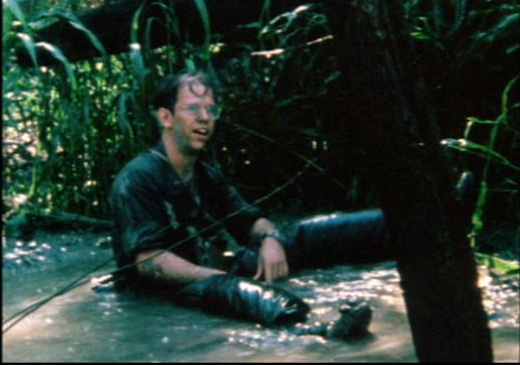

The image texture and size shift as the narrative jumps to the next New Year's Eve, 1965. Now that Terry's in Vietnam, living the reality of life as a soldier, his whole attitude has changed. He just wants to get home alive and reunite with Debbie, and his plan to make that happen involves sustaining an injury. Alone in the jungle, he hangs his rifle on a tree and tries to shoot himself in the arm with it. Instead, his gun jams as he slips and falls down in the mud. Aww... poor unlucky Terry.


Then the rifle does go off accidentally, and some of the shots hit the perimeter of the base where the other soldiers mistake it for sniper fire. In response, the base blasts the bushes with a barrage of bullets and bombs. Terry scrambles for cover as explosions go off all around him. Being aware that this is also supposed to be the last day in Terry's life, the scene should feel dangerous and menacing. At any point, some combat situation like what we are seeing now will result in the death of Toad. But instead of presenting it in a serious manner, the film plays this scene for comedic effect, making it almost borderline-slapstick. A few reviews at the time of the film's release took issue with the Vietnam scenes for making light of the wartime experience, and I have to agree this scene feels like a not-very-funny misstep. Terry's death is no laughing matter.


The film abandons Terry for a moment as the explosions shift into a series of psychedelic abstract images (mostly taken from Scott Bartlett's 1972 short film "OffOn") and we skip ahead one more year to New Year's Eve in 1966. Debbie has relocated to San Francisco and Carol (now calling herself Rainbow) has made the move along with her. When we join her, Debbie is driving along with her current douchebag boyfriend Lance (John Lansing). She's musing about what a depressing day it is for her, having lost John to the car accident at the end of '64 and Terry in Vietnam on the final day of '65. She still speaks fondly of Terry, of how sweet he was to her and how he wanted them to get married. Lance, sitting in the passenger seat as he rolls a joint, barely pays any attention to what she's telling him. Not only is it depressing watching Debbie settle for this obvious jerk after being with a great guy like Terry, being reminded that two favorite main characters are about to have their lives abruptly cut short is a real bummer too...


There's a jump to Modesto 1967 for Steve & Laurie's plotline, followed by a big leap back to Fremont 1964. This is the dance the storyline does for the remainder of the running time (three steps forward, one leap backwards). With this second scene in '64, we see the five main characters together for one last time before the narrative scatters them on their own individual paths. It's a shame there won't be anymore scenes of Terry and Debbie together, since it was fun to see them share the screen again after having enjoyed their pairing so much in the original film. The sequence ends with Milner's somber plea to Terry to come back from the war alive. One doomed character unknowingly commenting on the other's inevitable fate...


We return to Toad in '65's war zone, as "Stop! In  the Name of Love!" by The Supremes blasts dramatically from the soundtrack. Stop indeed! Before you break my heart by killing off sweet adorable Terry before my eyes! As the smoke clears, the American troops are surprised to see their familiar fellow foot soldier staggering out of the smoke and waving a white flag of surrender. Amazingly, Toad sustained no serious injuries while under fire (beyond a small scrape on his hand). The commanding officer Major Creech (Richard Bradford) seems pretty suspicious as to what Terry was doing outside the base perimeter alone but is too distracted by the presence of a visiting congressman to push the issue. Thank goodness. Terry's off the hook for now...


Coincidentally, Little Joe of the Pharaoh's gang also happens to be stationed at the same base with Terry. Although the characters never shared any screen time together in the first "Graffiti" film, they seem like good pals now. They're both newly assigned to chopper detail under aircraft commander Bob Sinclair (James Houghton). Terry flat-out tells him: "I don't want to disappoint you sir, but you got yourself in with a couple of cowards here. We like things safe and easy." But when Sinclair responds that he has volunteered them for med-vac duty, Terry totally loses his cool. "Happy Goddamn New Year!" he shouts as he furiously stomps away. Soon, they're on their first mission together, and it becomes clear very quickly that Joe and Terry are far more experienced in matters of combat than Sinclair is. His poorly thought-out flightpath  puts their 'copter in the line of enemy fire, and they're hit by several rounds of gunfire. If only Sinclair had listened to Terry, who knew they were in danger...


The humor that has run through the Vietnam sequences up to this point disappears with this scene, which seems to be going for a more serious approach. I wonder if the change of tone is possibly due to a different director filming the scene, since George Lucas also shot some of the Vietnam footage (supposedly some of the combat material... uncredited, of course). Although the movie is now trying to present a more realistic depiction of the war, it seems there are still a few jarring plot problems that keep it from feeling really and truly believable. To quote from the IMDb page for the film:

"Toad is portrayed as a helicopter pilot, wearing the appropriate rank of a warrant officer, yet he is treated as a low-ranking enlisted man who takes orders from the First Sergeant and is placed on details for enlisted men. Normally, this would not be the case, as a warrant officer outranks a First Sergeant, and therefore would not carry out such tasks. Additionally, Toad's poor vision would have most-likely precluded him from being a helicopter pilot in the first place."


Their 'copter finally reaches their pick-up point: retrieving a group of wounded soldiers on the edge of an active battlefield. As the injured troopers are loaded onto the aircraft, the loud screams of one of them fills the air. You don't see any battlefield gore, but the juicy gurgling in his screaming is pretty disturbing: the awful sound of a man choking on his own blood. Even though Terry identified himself as a coward, he handles this all very well, jumping into action and tending the wounded without hesitation. Not surprisingly, Sinclair is absolutely horrified. "Don't worry," Toad shouts over the noise. "You don't get used to it." So of course sweet Terry is not numb to the atrocities, he's just good at holding his shit together: an impressive soldier after all...


There's a shifting of gears as the comedic elements quickly return to the movie. When we rejoin Terry, we come to what is of course a highlight for me: Charles taking off some clothing! Woo hoo! Bare-chested and covered in mud, playing a rowdy and spirited game of football with the other soldiers, I find my eyes coming back to and lingering upon Charlie's finely fleshed body. It's funny how not even the dirty muck all over him can ruin his appeal for me. Even covered in mud, I still think Charles Martin Smith is the sexiest man alive.


As Sam the Sham's "Wooly Bully" plays on the soundtrack, giving the whole thing a party-like atmosphere, the guys run around slipping and sliding in the slick sludge. Although the motion is too fast and blurry to get a good screen capture, at least I get a few moments where CMS stands still for a second so I can savor his shirtless sexiness more clearly. As I sit and ogle, Terry begins to formulate a plan when he sees the increasingly rough game claim a victim (who lets out a Wilhelm Scream when he's crushed under a tackling pile of men). An injured soldier hurt while playing is carried away to the infirmary while a lightbulb goes off over Toad's head. Getting injured in a bout of macho roughhousing seems a whole lot easier than trying to shoot himself in the arm!


He spots a particularly huge brute of a man and walks over to position himself right in the big guys path, anticipating an especially injurious tackle. And I insist on illustrating the fact with another gratuitous shot of an adorably mudcaked CMS. Gosh, it's enough to provoke steamy fantasies of unclothed mud wrestling with Charlie, even though that's not something I have ever fantasized about before in my life. Mud's not my thing, normally...


The instant the larger player lunges forward, he looses his footing and serously hurts his leg, falling to the ground and writhing in pain. An incredulous Terry is left stands over him, deeply disappointed to have missed his chance to get that much-needed injury. "Some guys have all the luck," he grumbles as he storms away. Gosh, he's so cute when he's stomping mad...


When Terry explains his "ticket home" strategy to a confused Sinclair, Major Creech happens to step up behind him and overhear the whole plan. As punishment, The Toad has now been assigned to latrine duty for an entire month, starting immediately! Oh no! Poor Terry... what a crappy New Year's!


Latrine duty requires a training lecture, delivered by an army sergeant played by Delroy Lindo in one of his first film roles. He's not the only actor making an early-career appearance in this movie:  Scott Glenn, Mary Kay Place, Naomi Judd, Rosanna Arquette and Nancy Fish all pop up among the cast as well. But I digress... As he wipes off the football mud, Terry's cops an attitude and rejects his latrine lesson. "Don't give me that crap," the sergeant growls. "Don't give me this crap!" Terry replies loudly. But sadly, there's no getting out of it, and there's a load of shit waiting to be taken care of.


Like in the first film, many of the rock songs on the soundtrack are heard coming from radio speakers in the background of various scenes. Smartly, someone decided that a popular tune might not be a good match to a depiction of someone having to dispose of fecal matter. So what do we hear instead? It's a radio public service announcement of the dangers of untreated venereal disease. Haha... Cute. Meanwhile, Terry still hasn't put his shirt back on, which I'm surprised about. I figured he'd want to cover up his chest or face if he's carrying around big metal tubs filled with piss and shit, all pressed up against his chest as it sloshes around under his nose. But hey: it's an excuse to see some more shirtless CMS, so I won't complain. 


As he sets down the tub o' turds in preparation for cremating the contents, he tries to gives it an angry kick. Oops! He slips in the mud again, going down hard and landing on his ass. Oh Charles, you make klutziness so adorable. And I have the screen caps to prove it. 


Take a look at this production still for the movie. I think it's interesting that once again an image of Charles Martin Smith with his shirt off is used in a film's promotion (see "The Spikes Gang" and "Rafferty and the Gold Dust Twins" for other examples). I'm not sure if this was just a set photographer's staged shot, if it's a deleted scene or even an alternate take of the overheard conversation with Sinclair, when Terry was still freshly covered in mud. In any case, it's very nice to look at CMS sans shirt again. Getting older, looking hotter...


It's a busy New Year's Eve for Terry, as he joins Sinclair and Little Joe on another helicopter mission. Toad mentions the significance of the day for him in a conversation with Joe remembering John Milner's death the previous year. It's another reminder that our main characters are in danger and can die at any time. In the next scene with Laurie in 1967, she even mentions Terry dying in the war, prodding us again with the foreknowledge of the poor guy's fate. And of course right on cue the three of them fly into a hot zone of enemy activity, a rain of bullets striking their 'copter. Yikes! They're really in trouble! Before you know it, the aircraft goes down in a haze of smoke and flame, crashing into the trees below.


But don't count Terry out just yet. He's managed to survive the impact, but he might have found himself in one of those "out-of-the-frying-pan-into-the-fire" situations. Their location is heavily under fire, and a group of Vietnamese soldiers is shooting at them from just across the river. Terry manages to contact a nearby 'copter over the radio that could fly in and rescue them. Unfortunately, their potential savior is none other than Major Creech, who tells them they'll have to sit tight until the situation on the ground gets less hairy.  


Sinclair figures out and voices what Terry knew all along: Creech is afraid to come down to get them. There's another series of shots from across the river, forcing them to respond with a volley of gunfire. As they continue to defend their position and wait for rescue, I'm going to draw this entry to a close. I've rambled on long enough about this particular movie, and spoiled enough of Terry's story. Just go watch it already, you might be surprised how it all ends up turning out for everyone. I am guessing there's a good chance you haven't seen this particular film. When I asked people I knew what they thought of the "American Graffiti" sequel, just about all of them told me they didn't even know this movie existed (including friends who said they're big fans of the original film). So give it a shot. Despite the flaws, it really is worth watching.


I think a big part of my own personal enjoyment of "More American Graffiti" was the opportunity to see CMS reprise his iconic "adorable nerd" role one more time. As I would expect, he does a great job of maintaining strong character continuity, as do the other lead actors. All of them deliver impressive performances, especially when you take into account the occasionally weak script they had to work with. Also, there are a few scattered moments that almost capture some of the magic of the first movie. The final shot of the film in particular is very powerful and moving. And there's even a chance to briefly hear CMS sing again: just "Auld Lang Sine" of course. It is New Year's Eve, after all. 


It isn't very far from New Year's Eve 2012 right now as I wrap up this entry, and I'm looking back over this last year spent going through as much of Charles Martin Smith's 1970s filmography as I could find. Getting my paws on 18 out of 24 titles isn't so bad, huh? I have to say it's been quite enjoyable watching these movies and TV episodes chronologically, seeing him grow as a talented actor and develop as a seriously attractive guy. CMS definitely ended the decade on some high notes (we won't talk about "A Dog's Life" anymore), but I'm happy to say it gets even better. The 1980s provide us with the most famous work of Mr. Smith's career, as well as a view of the man at his absolute sexiest. Coming up, we'll take a sneak peek at what lies ahead of us, including my favorite CMS film of all time: "Never Cry Wolf" (1983).

Tuesday, October 23, 2012

GEORGE + BRENDA: More from "Cotton Candy" (1978)

I'm having a little trouble with this entry's film, "Cotton Candy" (1978). With Charles Martin Smith featured in almost every scene playing the main character, high school rock band leader George Smalley, there ends up being too much captivating cuteness and heartbreaking hotness to be contained in just one post. Despite the reputation the film has for being squeaky-clean and innocently naïve, there are surprising undercurrents of sexuality that occasionally come bursting out at unexpected moments (see last entry's strip poker scene). This leaves me with much to say and many screen caps to share. 


I've already admitted several times how much I love the sight of CMS holding a guitar, and you might have noticed the plentiful images of him and his instrument to be found here. But there's more to my enjoyment of this movie than just CMS and anything appealing he brings to his part. It's true, the film is somewhat dated and the dialogue is occasionally cheesy (amusingly so). But at it's core is a compelling and entertaining piece of storytelling that vividly and engrossingly details a high school misfit's efforts to find his place in the world and have his meaningful moment of musical merriment. I don't understand why director/co-writer Ron Howard would not be proud to have "Cotton Candy" seen today, but it's rumored he's intentionally keeping it locked away and off the market. Gosh, if Howard can stand behind an unwatchable misfire like "How The Grinch Stole Christmas" (2000), then he can certainly embrace this charming cult classic.


It's fun seeing CMS in a romantic role again, something I've only seen him do so far in "American Graffiti" (1973). Like Candy Clark in that film, Leslie King is lovely and likable. And like that hit film's pairing, it just feels good to watch the two of them share a scene together. Let's rejoin George Smalley (CMS) and Brenda Matthews (King), shall we? Brenda approaches George at school as he sits on some steps working on new Cotton Candy songs. After chatting a bit about their classes, she asks if he's free before the next band practice to help her work out some of the harmonies she's struggling with. How about 8:30 tonight, after he's through at work? Awww... it's so cute watching them take these tentative little steps towards dating.


That night, after a pleasant evening together talking and harmonizing, George (with some gentle nudging from Brenda) gets up the nerve to ask her out for dinner and a movie. Of course she's interested. How could she not be falling for this adorable guy? After they agree on next week Friday for their date,  George leans in and gives Brenda a little kiss. Awww! Such cuteness goin' on! As he rolls off into the night on his bicycle, a sweet instrumental melody starts to play on the soundtrack. We'll later hear it's a tune that George has been writing to play for Brenda.


We next see the budding lovebirds on Date Night, leaving a movie theatre together. What did they go to see? I'm not sure, because an unseen staff member is in the process of removing the title from the marquee as the scene begins. All that remains of the date movie's name is the letters KY. Hmmm... Should I read anything into that? Maybe it is an intentional lubricant reference, since there seems to be more subliminal messages planted in the scene by director Ron Howard. As George and Brenda walk down an alleyway running along the side of the theatre discussing the film they just watched, we see a series of movie posters on the wall next to them. The first poster we see is for "The Goodbye Girl" (1977), which would seem to reference Brenda's eventual departure to attend MIT in the fall. The last poster they pass (and George even bumps into it, before he stops and leans against the wall) is for "High Anxiety" (1977), mirroring George's nervousness about the date in progress (or perhaps his concern about how the band is doing). 


Brenda is criticizing the movie they watched for being unconvincing, pointing out how it's unrealistic for the main character to be such a loser then turn around and be a big success at the end. This seems to strike a nerve with George, who not only seems to have identified with the character in question, but also possibly feels like they could just as easily be talking about him. "It's kind of nice to be able to think that even if it's a long shot that a guy who isn't doing so hot can turn it around," he say to her (at the moment he bumps into the "High Anxiety" poster). "I mean... I don't know," he continues awkwardly. "What... Like our band," he adds, starting to sound a little more confident. "We're long shots. But what if we actually won that 'Battle of the Bands'? I'd like to think that stuff like that can happen. And I do. I do think that." They both smile hopefully and put their arms around each other as they continue down the alley to Brenda's car.


They pull up to George's house, and there's some more awkwardness as George wants to kiss her, but instead he's nervously chattering in a joking manner. Brenda puts a stop to it, taking the initiative and planting a wet one on his lips. Oh, romance.... They begin to tenderly make out, and the scene fades to the exterior of the parked car, the steamed windows obscuring any activity that may be happening inside. How long are the two of them at it, and how far do they take it? The movie never reveals (there's no Brenda-gets-pregnant plot line or anything like that later), but it is easy to assume that they went all the way together. Maybe I'm just projecting myself into the situation, because I would definitely give it up to George Smalley on the first date.


I would have thought the film would save the Battle of the Bands for the finale, but halfway through the movie we are already at the event. It's being held at the Town East Mall in Mesquite (on the edge of the Dallas/Fort Worth Metroplex), in a large open area in the center of the building (complete with a revolving stage). Cotton Candy are moments away from performing, and George does what he can to calm the tense band before they go on, as he struggles with his own mix of nervousness and excitement.


I complained last entry that a lot of the YouTube clips for "Cotton Candy" have been recently removed. The entire "Battle of the Bands" sequence used to be on there for all the world to enjoy, but is no longer. However, there is a piece of the scene: Cotton Candy performing the song "She Rolls" (which seems to be a fan favorite among the lucky few who have seen this rare cult classic). It is one of their better songs, with George apparently singing about that date night with Brenda. Possibly even about hooking up with her... or at least the pleasures of being horny (that lyric "When she holds me I start to quiver" tells me something orgasmic may have been involved). Check out the clip and see for yourself before it too is inevitably removed for copyright violation.


After the applause dies down, Cotton Candy launch into a second song (a repeat of one heard earlier during the band practice montage, "Not Gonna Hold Me Down"). The scene fades to the next group of performers going on as George and his group celebrate their success backstage. When the announcement is made naming the 4 bands selected to compete in the final round later that night, of course Cotton Candy is one of them. The bandmates cheer in delight as they hoist George up on their shoulders and pump their fists in the air! Woo hoo! 


Since rival band Rapid Fire won the Battle last year, they automatically skipped the preliminary round and were also included in the final four. Their arrival that night is a big circus of screaming girls as leader Torbin Bequette (Mark Wheeler), dressed like some 1970s version of a 1930s gangster, stands on a moving electric cart chased by his adoring fans. As he heads backstage with his entourage, Torbin steps up to Cotton Candy (who have just finished setting up for their next performance) and looks George right in the eye. "You turkeys made the finals?" he smirks. "I can't believe it, competition's really slim!" And off he strides with his gaggle of groupies. But George doesn't let that smarmy little douchebag rattle him. You show 'em who's best, Smalley!


I mentioned last entry how I didn't know the official names of the Cotton Candy songs performed in the film, since the end credits are missing from the bootleg copy I ended up getting my hands on (and there's no soundtrack album). Cotton Candy starts their set with a new song, which I am going to guess is called "Making My Music" (which is a sweet and sincere little ditty about the pleasures of musical creation). As with the other Cotton Candy tunes, I think it's fun and catchy, and CMS gives a charmingly energetic joyfulness to the presentation.


Some sample lyrics from "Making My Music": "I get high just making my music / I get fine behind a rock-and-roll band / And when I'm old and grey / I just want to sing and play-ay-ay yeah / Making my own music just as loud as I can." Sing it, Charlie!


The film fades to an instrumental jam session starting with an impressive bit of drum playing from Brenda followed by an intense little guitar solo from George. The audience eats it up and responds eagerly and loudly, much to the irritation of Torbin Bequette. I'm responding to the performance too, but a lot of that probably has to do with how hot I think CMS looks with guitar-in-hand. 


We get to hear one more fragment of a Cotton Candy song, admittedly the silliest one of the bunch (but not without it's charms). This one is called "Starship" (which, this being the post-"Star Wars" world of 1978, is probably a nod to the sci-fi trend taking over pop culture at the time). It's another entertaining feel-good hit with the audience... and I must admit I like it too, despite the absurd goofiness of the lyrics. Gosh, I sure wish there was an official soundtrack album out there. I wonder what the hot pic of Charlie adorning the cover would have been like if such a record existed? 


Unfortunately, Rapid Fire has already got an established fan base in attendance whose screaming adoration nearly drowns out their wretched cover version of "I Shot the Sheriff" (which seems to be the only song the band knows). George and his bandmates laugh at Rapid Fire's awfulness, but most of the people in attendance go crazy for it. So who wins the title? Is it popular choice Rapid Fire? Or is it the clearly more-talented Cotton Candy that gets the grand prize? I'm not sayin'. I've been bad enough about the spoilers as it is. You can look somewhere else for the answer, buddy.


There is one more scene in the film I want to mention before I  bring this entry to an end. It's really one of the highlights of the movie for me. Brenda visits George at his evening job working at a taco stand, and discovers he has a little surprise for her. He asks her to meet him out back behind the kitchen in a few minutes, then he shouts to his manager that he is going on break for a little bit.


George walks out the backdoor to find Brenda waiting for him. He steps towards her, his guitar in one hand, a boxed gift in the other. See, George worked it out and figured that today marked their two month anniversary (I'm not sure what he's using as the starting point, though). Brenda opens the present (a diamond pendant) and of course she loves it, but the best part is yet to come.


"I've got this song," he says to her. "It's just this little tune that I'm working on, and I've never really written anything like it before. Let me play it for you, OK?" And he sits her down by a stack of milk crates and begins to play a sweet little love song, one that I assume would be named "I'm the Kind of Guy Who Loves You" (or maybe just "I'm the Kind of Guy"). Of course, I am a huge sucker for this particular bit of music, which is one of two favorites I have in this film.


This video here is admittedly not a good-quality presentation of the song in question (I'm generally not a fan of those "point your cam at the TV" clips), but it's one of the last remaining "Cotton Candy"   scenes left on YouTube, and at least it will give you some idea of what it sounds like. I really think Charles sounds fantastic here, his vocal delivery seeming to display a touch of Buddy Holly influence that must have rubbed off from that previous stint playing in "The Buddy Holly Story" (1978). And you know what? Every time I hear CMS sing this, I  start to cry. Every single time.


When he's finished, George looks pretty happy with his heartfelt display of the true feelings he has for Brenda. And if I were in her shoes, I'd just throw my arms around him and be grateful to have found the greatest guy on earth at such a tender young age. Being such a huge fan of CMS, and having my own feelings of admiration and attraction to the guy, the chance to see him play such a wonderfully romantic scene really appeals to me. And I gotta say: this sequence here ranks among my all-time favorite CMS moments I have had the pleasure of watching since I started this whole immersion in Mr. Smith's filmography.


So... what is Brenda's response to George's sincere showing of songmanship? Like a few other things in this movie, the plot doesn't go the predictable route and unfold the way you'd expect it to. There's still way more sexy CMS moments ahead, many more compelling moments of humor and drama, and there's even another great Cotton Candy tune ("Born Rich", which would be my other favorite song in the movie besides "I'm the Kind of Guy"). In any case, I've opted to refrain from spoiling the last chunk of the storyline. If you go through all the effort to obtain a copy, you deserve an unspoiled ending. Right now, options for seeing the movie are sadly limited. It's possible you'll track down a bootleg copy like I ended up doing, or perhaps you'll find a used copy of the novelization to read and savor ("8 pages of photos!" Woo hoo!). Who knows? This particularly rare piece of '70s TV may finally find it's way into general release on disc or download (ideally, with a behind the scenes documentary and audio commentary with the Howard brothers, CMS and Leslie King). Maybe one day... and then the whole world can enjoy the wonderfulness that is "Cotton Candy" in all it's splendor. In the hopeful words of George Smalley himself: "I'd like to think that stuff like that can happen. And I do. I do think that."


I'll leave you with one final clip: an absolutely incredible tribute to "Cotton Candy" created by an extremely creative super-fan of the film. It's a song composed ENTIRELY of dialogue taken directly from the movie, strung together in an amazing arrangement of awesomeness! Bravo, buddy! Very nice work! Take a look and prepare to be entertained.

Friday, October 5, 2012

REALLY ZOOED OUT: "Cotton Candy" (1978)

Wow! This entry's film, "Cotton Candy" (1978), is a real hidden treasure: pure CMS gold! Never released on home video in any format, and aired only a handful of times on television, this seriously neglected film lives on in faded digital transfers from old VHS copies taped off TV. Lucky for us, since otherwise we might not have knowledge today of the awesomeness that is this film. Despite it's rarity, a small cult following has managed to build up around it. Maybe one day someone will see fit to give it a proper official release... One can hope. This energetic, entertaining, and exciting endeavor definitely deserves a fervently fanatical following!


24 year old Charles was cast in the film as an 18 year old high school senior. Thanks to his boyish good looks, shorter stature and youthful exuberance he manages to more-or-less pull it off convincingly (certainly more convincingly than some of his over-age co-stars). Previous CMS co-star Ron Howard, in his 2nd directorial feature after "Grand Theft Auto" (1977), worked from a script co-written with brother Clint Howard (who also appears in the film). Originally aired on NBC on October 26th, 1978, the copy I got my hands on was taken from a videotape of a 1981 rerun (several of the fun-to-remember commercials the original videotaper left in were copyright dated '81). Here we see the first time Charles Martin Smith was finally cast as the main character in a film. Up 'til this point, every one of his roles had either been a supporting one, or was part of an ensemble (such as "American Graffiti" (1973) or "The Spikes Gang" (1974) ). But here, we get an incredibly adorable and sexy CMS in practically every scene of the film! It's totally his movie! Fuck yeah!  


We are first introduced to CMS's character, George Smalley, struggling to fit in with the rest of the varsity football team at Lake Highlands High School. While the other guys are smacking each other's asses and chasing each other around the locker room in their tight little shorts having touchy-feely towel fights, George seems kind-of stuck on the sidelines. He does seem to give off a vibe of not-belonging... and appears a little uncomfortable with being left out of the main action. As he changes his clothes after a shower (which we don't get to see, sadly), two beefy players wrapped in towels on the bench next to him have a conversation about their more-exciting lives. "He wants me to go both ways," one of them confides to the other. Before we can hear any more of their potentially provocative discussion, an announcement comes over the locker room speakers: "George Smalley, report to the head coach's office immediately."


As George nervously walks through the locker room to the office, other players pointing and whispering as he passes them, we are presented with a flashback to junior year. George is trying to relax in his living room, looking at his vinyl collection while his mom flips through the school yearbook. She starts hassling him: where are his extracurricular activities (of which he has had none)? She then starts pushing him to be more active in his senior year, the year that really counts. Aw, mom. Why do you have to be such a nag? We then see him making the impulsive decision to join the football team, buying expensive cleats and ignoring his dad's objections. "But dad, think of what people are gonna say when I get a varsity letter," George responds. "What an outrageous way to finish high school!"


We then see a quick montage of Smalley busting his butt on the football field, doing endless jumping jacks and running up and down the bleachers (and looking really cute doing it... but doing it too fast to get a good screen cap, of course). Awww, this guy's been working so hard to be a part of the team. But as we see when the flashback ends and we come back to the present in the office, Coach Grimes feels it's too little too late. "If you were a junior..." the coach starts to say. "But I'm not," George interrupts. "I'm a senior!"


When the coach offers him a position helping in the equipment room instead of a place on the varsity team, George takes offense, refusing a lowly role handing out towels. So Grimes flat-out kicks him off and orders him to turn in his uniform and gear. No one on the team seems like they're going to miss him either. As he clears out his locker, other players point and comment. "Smalley's history," one of them laughs. Aww, poor George Smalley. He looks so crushed, so unappreciated... 


At least George isn't facing his problems alone. His best friend Corky MacPherson (Clint Howard) is always willing to lend a sympathetic ear. George blows off the football game that night, but Corky insists they go to the dance so they can meet some chicks. "I wish I could get a girl," George says, though he admits it's only to get his mother off his case, because she thinks her son's "a homo or a wallflower". Well, moms usually figures these things out early, they have a sense for these things... Meanwhile, the dance is absurdly crowded, urging George to make the following observation: "Jeez, what a zoo. This place is really zooed out." Haha, brilliant! This here is one of the many charms of the movie: it's ridiculously dated (and endlessly quotable) teen lingo dialogue. I'd also like to point out how cute CMS's butt looks in his snug bluejeans, but the shoddy picture quality prevents us from getting a really good look. What a drag...


Performing on stage at the school dance is Rapid Fire, a laughably horrible and inexplicably popular rock band led by egotistical douchebag Torbin Bequette (Mark Wheeler). The band presents a mangled cover of "I Shot the Sheriff" to the adoring teen audience (well received especially by the girls, who are extra-worked up by Torbin's overblown antics), but George smartly sees through their lack of talent. Corky, hearing that one of their guitar players quit, urges him to ask Torbin if he can become his replacement. During an intermission ("Rapid Fire's just gotta reload a little!"), George approaches him and asks for a chance to try out for a place in the band. Of course Torbin responds with a shitty attitude, shooting him down and humiliating him to the amusement of his bandmates and giggling groupie girls. But George is gonna show him! He hatches a plan to get his own band together, one that will knock everyone's socks off with their rockin' skills. Maybe then they could beat Rapid Fire in the upcoming Battle of the Bands competition at the local mall! Corky seems even more excited about the idea than George does, as he literally squeals with delight at the thought of the future band's future awesomeness.


Corky runs an ad in the school paper looking for potential bandmates. He also writes up an announcement he has made over the school PA: "Get down, get down: rock on, brothers! Experienced musicians, turn yourself on. Join Smalley's hot new rock band. Call real soon or be a baboon!" George isn't too keen on the choice of words used, but Corky contends that it sounds great. "The baboon is key!" he insists. Later, when George brings home a $300 electric guitar from the pawn shop, his parents are pretty vocal about their disapproval. Mom gripes that he had a perfectly good guitar already (an acoustic one), and dad rubs his face in the expensive cleats he doesn't use anymore. Neither one of them thinks George will be able to form and maintain a rock band. Thanks for the encouragement... The phone rings, mom answers it. "Somebody named 'Julio' with something about a 'jam session',"she tells George, sounding more than a little confused. He turns to her defiantly: "I'm telling you, mom! This band's gonna come together!"


Jam session, indeed! George arranges to have interested musicians show up at his place: along with Julio (fellow "American Graffiti" cast member Manuel Padilla Jr), brothers Barry (Kevin Lee Miller) and Bart (Dino Scofield) arrive with instruments and amps in hand. There's also a red VW Beetle that pulls up in front of George's house. "Is this where the new band's getting together?" asks the cute brunette girl who leans out the car window. "A chick for a drummer?" Corky wonders aloud, and the others share his initial skepticism. "Hey, she's a fox," Julio observes. "But can she cut it, man?"


The "fox", whose name is Brenda (Leslie King), just calmly sits herself behind her drum set and starts into a slick little percussive solo. Hey, she sounds great! The others hop on their instruments and start playing a funky little improvised tune, sounding like they've been jamming together much longer than the 15 minutes they've known each other. Wow, Charles looks so hot standing there, instrument in hand. Don't you think? Corky, who's been chosen by George to be the band's manager, smiles and nods his head approvingly as the jam-out continues. Unfortunately,  the crabby old lady next door passive-aggressively turns her backyard sprinklers on, dousing the band and bringing the sweet music to a stop.


Dripping wet, George goes inside and tries pleading with his mom to talk to their senile senior neighbor next door, but once again there is no sympathy or understanding. Jeez, his parents are so discouraging and unsupportive that it's no wonder George feels like a bit of a loser who's less-than-a-success at anything. Now the band has nowhere to practice and George is beyond frustrated. "Rinky dink!" he loudly grumbles, and storms out the door to the backyard.


The others are sitting on the grass, their moods apparently not dampened by the abrupt ending of their practice. George seems ready to call it quits as he walks over to the others, but I'm distracted by the snug shirt and jeans he's wearing, which seem to cling to his sexy body even more since they're still wet from being sprayed with sprinkler water. Oh gosh, there I go again...


Instead of calling off the meeting, Corky suggests they spend some time getting to know each other better instead. After some initial nervousness, they open up to each other: Brenda's got a scholarship to go to MIT, but needs a break from studying all the time and worrying about grades. Julio used to be in a gang but he quit when they started getting too "radical" for him. George admits to being kicked off the football team. Corky thinks that they should take their cue from the new wave trend catching on and should call the band "Hot Rash" but no one else likes that particular idea (they later settle on Cotton Candy with no explanation why the name was chosen). Such a sweet and sunny afternoon of smiles and sharing over chilled cans of cola...


"I really think we've got a shot," George tells them as their meeting wraps up. "The Battle of the Bands... see, if we could ace that thing, can you imagine how outrageous that would be? I don't know...  It would just be so great if this was the one thing that finally works out..." Awwww, how could you not root for this frustrated fella?


Corky comes through for the band and finds them a better practice space in his boss's garage at night after close. Woo hoo! So now it's time for their first real band practice. After a little fumbling with the arrangement, we are then treated to the first original song in the film. It is here that Charles Martin Smith was able to take his musical genius one step further than he did in the previous entry's film ("The Buddy Holly Story") and not only sing the lead in the songs but also actually write the music himself too. Well... not technically all by himself, but in collaboration with Joe Renzetti (who also worked compositionally on the aforementioned Buddy Holly bio-pic's soundtrack). How much is Charles and how much is Joe? Who knows? But I must admit, whoever is responsible, I am a sucker for the sweet sonic confections they whip up. Cotton Candy, indeed...


Since the copy I have of this movie is missing it's end credits (and there is sadly no soundtrack album), I don't know what the official names of the "Cotton Candy" songs are. I'm going to assume this first one is called "Not Gonna Hold Me Down" (or is it "Not Gonna Hold Us Down"?). Here's some sample lyrics: "Well if you say I'm crazy and it might be so / But there's a feeling in me and it won't let go / Woah-oh / Not gonna hold me down / Well you can play to win and you can play it cool / But if you play it safe you only play the fool / Woah-oh / Not gonna hold me down."  Corny and cliché? Maybe a little, but Charles also has a pleasantly warm singing voice, and he gets a lot of milage out of his enthusiastic and sincere delivery.


The song continues playing over a montage of merry moments the band share together over the next few days. Among the scenes we see is a group visit to the school carnival, where they come across a water-dunk tank with Coach Grimes sitting in the dunk seat. To the amusement and cheers of his fellow bandmates, George hits the bulls-eye target with the ball he's given and drops the coach (who had previously treated him so harshly) into the water tank. Right on, Smalley!


There's also a moment that underlines where George and his Cotton Candy posse's place is in the senior social stratum at school. As they walk down the hallway together, they are approached by another cluster of students: the members of Rapid Fire. The two groups approach each other... Will George stay strong and face them down? At the last minute, he and his bandmates step aside and let Torbin and his clique shove by them. Awww, I guess they aren't ready to stand up to "the bad guys" yet. Meanwhile, "Not Gonna Hold Me Down" is still playing over the scene and another of the lyrics strikes a chord with me: "And if you say you love me / Well now that's alright / Put your arms around me / And we'll rock all night." Hearing that, you can easily imagine what lyrics like that do to a guy like me (who adores a guy like him).


The montage ends and the film cuts back to a dark and stormy night at the practice space. With a loud clap of thunder, the power goes out, cutting their rehearsal session short. But instead of going home and calling it a night, Brenda suggests they play a round of poker (which we saw them do together before in that montage we just got through). Even though she beat their asses the last times they played, the other guys seem to like the idea. But this time, they want to raise the stakes and make it strip poker. Woah, wait a second... strip poker? With Charles Martin Smith! Hell, yeah! George doesn't seem interested in the proposed activity, but Brenda takes the challenge and pushes to play. Someone hangs a cluster of flashlights over a table, someone else busts out a deck of cards, and everyone pulls up a chair. Alright! Here we go, people!


You see, George has been crushing on Brenda since the moment she showed up at his house for that first practice session. He doesn't want to seem to her like he's no fun, but he doesn't want Brenda being oggled by the other boys either. The rest of the band is eager to get their clothes off, Julio being the first to lose his shirt, the other boys following suit with various articles of clothing. It's not long before George has to take off his t-shirt, something he hesitates to do. That is, until Brenda urges him on with a flirtatious laugh. That's all the encouragement George needs, and he takes his top off with a dramatic flourish. Yow! 


But over the course of several hands, Brenda also begins losing some of her clothes too, which excites the other guys (who all leer at her increasingly exposed body) while making George very, very uncomfortable. Now she's taking off her pants. That leaves only her flimsy blouse barely covering her bra and panties. The other guys shift in their seats, in a shared state of erect awkwardness, while waves of jealousy wash over George.


When the power comes back on, George seizes on the opportunity to strongly suggest for the game to be dropped and the band practice to resume. Of course all the guys complain and Brenda doesn't want to look afraid, so the game continues. As the cards are dealt, George keeps ending up with solid hands. He discards one good pair only to draw another strong pair right after that. Darn... and as they all reveal their cards, it becomes obvious that Brenda's is the weakest at the table.


Knowing she lost fair and square, and not wanting to look like a chicken or a spoilsport to the rest of the band, Brenda goes ahead and begins to unbutton her blouse. As her top opens and the promise of her partially exposed breasts threatens to become a reality, the guys all stare in intense silence. Even George can't help but gaze upon her,  but he also can't help but lose his cool either.


He suddenly jumps to his feet and grabs Brenda's sweater from the nearby pile of discarded clothes, tossing it onto her in a desperately insistent attempt to cover up her body, and he begins shouting. "This it totally ludicrous! We got a good group here, we got a good thing going, and I am not gonna let you guys louse not up! Forget the game! It's over!" Everyone else at the table protests at the perceived unfairness, and even Brenda defends the fact that she lost the last hand and had to face the consequences. But George doesn't care what any of them say. It's his group and he's putting his foot down. That's that: game over. Then something happens... something so amazing, so incredibly sexy in that rock-god sort of way. George, still shirtless, strolls over to his guitar, and then...


Ohmygod! Did you see that? Did you?? One of the sexiest sights I have ever witnessed: Charles Martin Smith, shirtless, strapping on his electric guitar, confidently wrapping his hands around his instrument, ready to play! I feel overwhelmed, overcome.... oh, Charles... "Put your arms around me, and we'll rock all night," as you so eloquently put it! Uh huh!

We're just about 1/3 of the way through "Cotton Candy", but I have to stop and take a breather. That was nearly too much for me to take, and I think I need to lie down for a while. So my review of this surprisingly sexy slice of '70s small-screen cinema will be continued in the next entry. I hope you've enjoyed what's come so far as much as I have. See you next entry with more rock-star CMS!