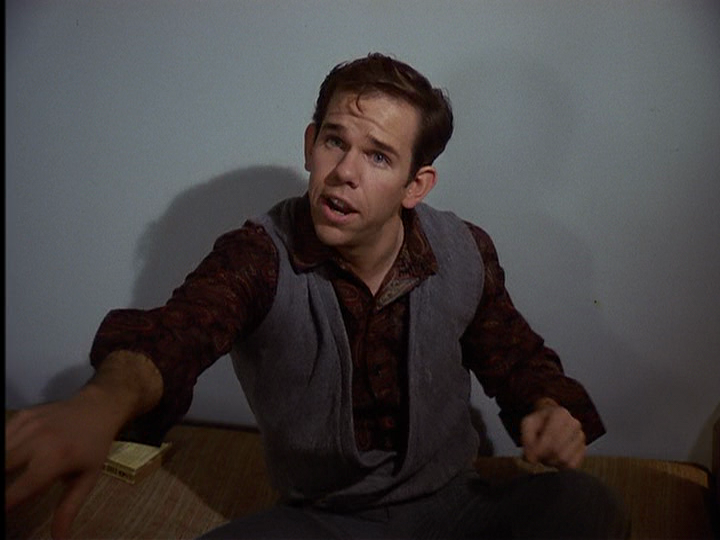
Back in the late 1970s, two of the most successful films of the decade had highly-anticipated sequels in production. Although George Lucas had directed both "Star Wars" (1977) and "American Graffiti" (1973), and was considerably involved in the making of their follow-up films, he declined returning to the role of actual director. One of these, "The Empire Strikes Back" (1980), of course went on to be considered one of the greatest sequels in cinema history. The other, "More American Graffiti" (1979), was not very popular with audiences or critics and was soon forgotten. Admittedly, "More..." was not as good a film as the original, lacking the organic magic of it's predecessor and feeling a bit forced in comparison. And yet I can't help but still enjoy "More..." despite it's flaws (and there are more than a few). There's also a lot of things the film did right, and it's easy to admire the movie's ambitiousness even if it falls a little short of realizing it's vision. Much has been said about how this sequel felt so unnecessary, but I would disagree. Considering what an interesting period the '60s were socially and historically, I think revisiting the characters from the original film and offering a view of the flip side to the innocence of the decade's earlier years feels like completing an unfinished story.

Like the movie poster here, the results are occasionally cartoonish and overblown. Something that helps a lot in anchoring "More..." is the strong performances from the terrific main cast. With the exception of Richard Dreyfuss, all of the major actors return to reprise their roles. In addition to CMS's Terry the Toad, we once again get to spend time with lovably kooky Debbie Dunham (Candy Clark), bad boy racer John Milner (Paul Le Mat), still-bickering now-married couple Steve & Laurie Bolander (Ron Howard & Cindy Williams), smart and sassy Carol Morrison (Mackenzie Phillips), and Pharaohs gang members Little Joe (Bo Hopkins) and Carlos (Manuel Padilla Jr). Even Bob Falfa (Harrison Ford) shows up for a brief cameo. Behind the camera is director Bill L Norton, whose previous films were "Cisco Pike" and "Gargoyles" (both 1972). His next film after this one: "Baby: Secret of the Lost Legend" (1985). He was considered a suitable choice by Mr. Lucas to replace him as the new writer and director due to Norton's California upbringing, which is a little interesting when you think about how Cali-centric "More..." really is. The whole movie was even shot entirely within the state of CA, including all the Vietnam scenes.

Another interesting aspect of the production is the decision to spread the narrative over four consecutive New Year's Eves (from 1964 to 1967), with each year given it's own visual style and mood. 1964 looks and sounds the most like '62 in the original film, with it's 2.35 scope cinematography, glistening cars and "Wolfman" Jack radio show playing in the background. 1965's Vietnam sequences are given a grainy news footage look with it's washed out colors and tight 1.37 aspect ratio. 1966's San Francisco setting is visualized in an almost psychedelic manner (reminiscent of the split screen/multiple images from 1970's "Woodstock" documentary). Modesto's mise-en-scène circa 1967 is presented in a more straight-forward manner, with it's suburban squabbling and political protests presented in a standard 1.85 image. Instead of a linear plotline, the 4 years are intercut with the narrative hopping back-and-forth in time. The film was heavily criticized for this storytelling approach, and even Lucas later said he felt it was a misguided concept. It's actually one of the things I like most about the movie. It's debatable how successful an idea it was in regards to telling the tales, but on a technical level it's sometimes dazzling to behold. Acclaimed cinematographer Caleb Deschanel was given one of his first feature-film DP gigs on this movie, starting his decades-long career on a strong point, his impressive visuals expertly edited together by Tina Hirsch (with uncredited contributions from Duwayne Dunham, Marcia Lucas and George himself).

With these things going for it, why is the movie ultimately considered a failure? The new plot concocted for this beloved cast of characters is admittedly a little uneven and sometimes feels uninspired, but at least it never gets flat-out boring. Part of the problem is the narrative is locked into certain specific plot points, all laid out for several of the main characters at the end of "American Graffiti" before the credits roll: John dies in a car crash, Terry perishes in Vietnam, Steve stays in Modesto, Curt is conveniently in Canada. Lucas fudged it a bit when he re-released a slightly revised "Graffiti" in 1978, changing the date of John Milner's car crash from June to December. But otherwise they had to "stick to the facts". At least this works in favor of the female characters in the movie, who are free to have whatever adventures the writers cook up.

The film starts with a shot flying alongside a group of US helicopters somewhere in the jungles of Vietnam (but actually filmed in the decidedly un-jungled wilds of Marin CA). Just as in the first one, "More" features an almost non-stop soundtrack composed entirely of popular tunes from the era. The first song we are treated to is "(Love Is Like A) Heatwave" by Martha & the Vandellas. It seems extremely appropriate that at the precise moment the vocals begin, Charles Martin Smith's credit appears on the screen. The opening lines ("Whenever I'm with him / Something inside / Starts to burnin' / And I'm filled with desire") seems to sum up the reaction I have when I see CMS in one of his movies or TV appearances. Filled with desire, indeed...

It's December 31st, 1964 when we join our five main characters at a racetrack in Fremont CA. It doesn't seem like much of a surprise that Steve and Laurie are still together, even if the two of them spend most of their scenes together bickering or arguing. I'm happy to see that Terry and Debbie have remained an item. Though unlike their pals the Bolanders, they aren't married and/or expecting. In contrast, John Milner's single status stands out. Presumably he's been so busy trying to transition from illegal street drag racing to professional sponsored racing there's no time left for for love. Later in the film he crosses paths with someone (Anna Bjorn) that could change all that. Lucky for him... or perhaps unlucky for him. From the get-go, we know that what we are watching unfold in the 1964 plot thread is the last day of Milner's life.

This also leads us to the other imminent fatality of the film. The group of friends isn't just there to show support for Milner's racing efforts, but to also give Terry the opportunity to say goodbye to John before being shipped off for combat in Vietnam. Terry sounds pretty gung-ho about the whole thing, laughing and cracking jokes the entire time: "Uncle Sam says, 'I need the Toad. Only way we're gonna win this one, get the Toad in there.'" Milner isn't laughing, but he doesn't want to rain on Terry's parade either. "Gonna go kick ass, huh?" he asks. All smiles, Terry responds enthusiastically: "Kick ass, take names and eat Cong for breakfast." And with that, he swigs his beer, puts his arms around Debbie and plants a proud kiss on her.
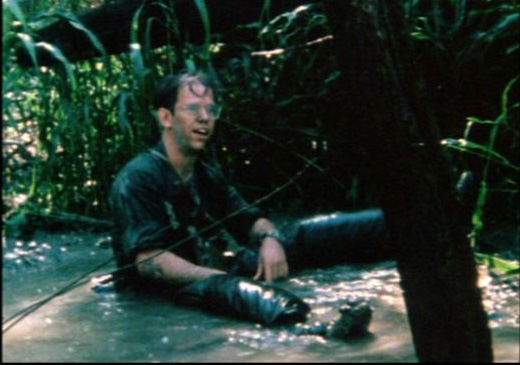
The image texture and size shift as the narrative jumps to the next New Year's Eve, 1965. Now that Terry's in Vietnam, living the reality of life as a soldier, his whole attitude has changed. He just wants to get home alive and reunite with Debbie, and his plan to make that happen involves sustaining an injury. Alone in the jungle, he hangs his rifle on a tree and tries to shoot himself in the arm with it. Instead, his gun jams as he slips and falls down in the mud. Aww... poor unlucky Terry.

Then the rifle does go off accidentally, and some of the shots hit the perimeter of the base where the other soldiers mistake it for sniper fire. In response, the base blasts the bushes with a barrage of bullets and bombs. Terry scrambles for cover as explosions go off all around him. Being aware that this is also supposed to be the last day in Terry's life, the scene should feel dangerous and menacing. At any point, some combat situation like what we are seeing now will result in the death of Toad. But instead of presenting it in a serious manner, the film plays this scene for comedic effect, making it almost borderline-slapstick. A few reviews at the time of the film's release took issue with the Vietnam scenes for making light of the wartime experience, and I have to agree this scene feels like a not-very-funny misstep. Terry's death is no laughing matter.

The film abandons Terry for a moment as the explosions shift into a series of psychedelic abstract images (mostly taken from Scott Bartlett's 1972 short film "OffOn") and we skip ahead one more year to New Year's Eve in 1966. Debbie has relocated to San Francisco and Carol (now calling herself Rainbow) has made the move along with her. When we join her, Debbie is driving along with her current douchebag boyfriend Lance (John Lansing). She's musing about what a depressing day it is for her, having lost John to the car accident at the end of '64 and Terry in Vietnam on the final day of '65. She still speaks fondly of Terry, of how sweet he was to her and how he wanted them to get married. Lance, sitting in the passenger seat as he rolls a joint, barely pays any attention to what she's telling him. Not only is it depressing watching Debbie settle for this obvious jerk after being with a great guy like Terry, being reminded that two favorite main characters are about to have their lives abruptly cut short is a real bummer too...

There's a jump to Modesto 1967 for Steve & Laurie's plotline, followed by a big leap back to Fremont 1964. This is the dance the storyline does for the remainder of the running time (three steps forward, one leap backwards). With this second scene in '64, we see the five main characters together for one last time before the narrative scatters them on their own individual paths. It's a shame there won't be anymore scenes of Terry and Debbie together, since it was fun to see them share the screen again after having enjoyed their pairing so much in the original film. The sequence ends with Milner's somber plea to Terry to come back from the war alive. One doomed character unknowingly commenting on the other's inevitable fate...

We return to Toad in '65's war zone, as "Stop! In the Name of Love!" by The Supremes blasts dramatically from the soundtrack. Stop indeed! Before you break my heart by killing off sweet adorable Terry before my eyes! As the smoke clears, the American troops are surprised to see their familiar fellow foot soldier staggering out of the smoke and waving a white flag of surrender. Amazingly, Toad sustained no serious injuries while under fire (beyond a small scrape on his hand). The commanding officer Major Creech (Richard Bradford) seems pretty suspicious as to what Terry was doing outside the base perimeter alone but is too distracted by the presence of a visiting congressman to push the issue. Thank goodness. Terry's off the hook for now...

Coincidentally, Little Joe of the Pharaoh's gang also happens to be stationed at the same base with Terry. Although the characters never shared any screen time together in the first "Graffiti" film, they seem like good pals now. They're both newly assigned to chopper detail under aircraft commander Bob Sinclair (James Houghton). Terry flat-out tells him: "I don't want to disappoint you sir, but you got yourself in with a couple of cowards here. We like things safe and easy." But when Sinclair responds that he has volunteered them for med-vac duty, Terry totally loses his cool. "Happy Goddamn New Year!" he shouts as he furiously stomps away. Soon, they're on their first mission together, and it becomes clear very quickly that Joe and Terry are far more experienced in matters of combat than Sinclair is. His poorly thought-out flightpath puts their 'copter in the line of enemy fire, and they're hit by several rounds of gunfire. If only Sinclair had listened to Terry, who knew they were in danger...

The humor that has run through the Vietnam sequences up to this point disappears with this scene, which seems to be going for a more serious approach. I wonder if the change of tone is possibly due to a different director filming the scene, since George Lucas also shot some of the Vietnam footage (supposedly some of the combat material... uncredited, of course). Although the movie is now trying to present a more realistic depiction of the war, it seems there are still a few jarring plot problems that keep it from feeling really and truly believable. To quote from the IMDb page for the film:
"Toad is portrayed as a helicopter pilot, wearing the appropriate rank of a warrant officer, yet he is treated as a low-ranking enlisted man who takes orders from the First Sergeant and is placed on details for enlisted men. Normally, this would not be the case, as a warrant officer outranks a First Sergeant, and therefore would not carry out such tasks. Additionally, Toad's poor vision would have most-likely precluded him from being a helicopter pilot in the first place."

Their 'copter finally reaches their pick-up point: retrieving a group of wounded soldiers on the edge of an active battlefield. As the injured troopers are loaded onto the aircraft, the loud screams of one of them fills the air. You don't see any battlefield gore, but the juicy gurgling in his screaming is pretty disturbing: the awful sound of a man choking on his own blood. Even though Terry identified himself as a coward, he handles this all very well, jumping into action and tending the wounded without hesitation. Not surprisingly, Sinclair is absolutely horrified. "Don't worry," Toad shouts over the noise. "You don't get used to it." So of course sweet Terry is not numb to the atrocities, he's just good at holding his shit together: an impressive soldier after all...

There's a shifting of gears as the comedic elements quickly return to the movie. When we rejoin Terry, we come to what is of course a highlight for me: Charles taking off some clothing! Woo hoo! Bare-chested and covered in mud, playing a rowdy and spirited game of football with the other soldiers, I find my eyes coming back to and lingering upon Charlie's finely fleshed body. It's funny how not even the dirty muck all over him can ruin his appeal for me. Even covered in mud, I still think Charles Martin Smith is the sexiest man alive.

As Sam the Sham's "Wooly Bully" plays on the soundtrack, giving the whole thing a party-like atmosphere, the guys run around slipping and sliding in the slick sludge. Although the motion is too fast and blurry to get a good screen capture, at least I get a few moments where CMS stands still for a second so I can savor his shirtless sexiness more clearly. As I sit and ogle, Terry begins to formulate a plan when he sees the increasingly rough game claim a victim (who lets out a Wilhelm Scream when he's crushed under a tackling pile of men). An injured soldier hurt while playing is carried away to the infirmary while a lightbulb goes off over Toad's head. Getting injured in a bout of macho roughhousing seems a whole lot easier than trying to shoot himself in the arm!

He spots a particularly huge brute of a man and walks over to position himself right in the big guys path, anticipating an especially injurious tackle. And I insist on illustrating the fact with another gratuitous shot of an adorably mudcaked CMS. Gosh, it's enough to provoke steamy fantasies of unclothed mud wrestling with Charlie, even though that's not something I have ever fantasized about before in my life. Mud's not my thing, normally...

The instant the larger player lunges forward, he looses his footing and serously hurts his leg, falling to the ground and writhing in pain. An incredulous Terry is left stands over him, deeply disappointed to have missed his chance to get that much-needed injury. "Some guys have all the luck," he grumbles as he storms away. Gosh, he's so cute when he's stomping mad...

When Terry explains his "ticket home" strategy to a confused Sinclair, Major Creech happens to step up behind him and overhear the whole plan. As punishment, The Toad has now been assigned to latrine duty for an entire month, starting immediately! Oh no! Poor Terry... what a crappy New Year's!

Latrine duty requires a training lecture, delivered by an army sergeant played by Delroy Lindo in one of his first film roles. He's not the only actor making an early-career appearance in this movie: Scott Glenn, Mary Kay Place, Naomi Judd, Rosanna Arquette and Nancy Fish all pop up among the cast as well. But I digress... As he wipes off the football mud, Terry's cops an attitude and rejects his latrine lesson. "Don't give me that crap," the sergeant growls. "Don't give me this crap!" Terry replies loudly. But sadly, there's no getting out of it, and there's a load of shit waiting to be taken care of.

Like in the first film, many of the rock songs on the soundtrack are heard coming from radio speakers in the background of various scenes. Smartly, someone decided that a popular tune might not be a good match to a depiction of someone having to dispose of fecal matter. So what do we hear instead? It's a radio public service announcement of the dangers of untreated venereal disease. Haha... Cute. Meanwhile, Terry still hasn't put his shirt back on, which I'm surprised about. I figured he'd want to cover up his chest or face if he's carrying around big metal tubs filled with piss and shit, all pressed up against his chest as it sloshes around under his nose. But hey: it's an excuse to see some more shirtless CMS, so I won't complain.


As he sets down the tub o' turds in preparation for cremating the contents, he tries to gives it an angry kick. Oops! He slips in the mud again, going down hard and landing on his ass. Oh Charles, you make klutziness so adorable. And I have the screen caps to prove it.

Take a look at this production still for the movie. I think it's interesting that once again an image of Charles Martin Smith with his shirt off is used in a film's promotion (see "The Spikes Gang" and "Rafferty and the Gold Dust Twins" for other examples). I'm not sure if this was just a set photographer's staged shot, if it's a deleted scene or even an alternate take of the overheard conversation with Sinclair, when Terry was still freshly covered in mud. In any case, it's very nice to look at CMS sans shirt again. Getting older, looking hotter...

It's a busy New Year's Eve for Terry, as he joins Sinclair and Little Joe on another helicopter mission. Toad mentions the significance of the day for him in a conversation with Joe remembering John Milner's death the previous year. It's another reminder that our main characters are in danger and can die at any time. In the next scene with Laurie in 1967, she even mentions Terry dying in the war, prodding us again with the foreknowledge of the poor guy's fate. And of course right on cue the three of them fly into a hot zone of enemy activity, a rain of bullets striking their 'copter. Yikes! They're really in trouble! Before you know it, the aircraft goes down in a haze of smoke and flame, crashing into the trees below.

But don't count Terry out just yet. He's managed to survive the impact, but he might have found himself in one of those "out-of-the-frying-pan-into-the-fire" situations. Their location is heavily under fire, and a group of Vietnamese soldiers is shooting at them from just across the river. Terry manages to contact a nearby 'copter over the radio that could fly in and rescue them. Unfortunately, their potential savior is none other than Major Creech, who tells them they'll have to sit tight until the situation on the ground gets less hairy.

Sinclair figures out and voices what Terry knew all along: Creech is afraid to come down to get them. There's another series of shots from across the river, forcing them to respond with a volley of gunfire. As they continue to defend their position and wait for rescue, I'm going to draw this entry to a close. I've rambled on long enough about this particular movie, and spoiled enough of Terry's story. Just go watch it already, you might be surprised how it all ends up turning out for everyone. I am guessing there's a good chance you haven't seen this particular film. When I asked people I knew what they thought of the "American Graffiti" sequel, just about all of them told me they didn't even know this movie existed (including friends who said they're big fans of the original film). So give it a shot. Despite the flaws, it really is worth watching.

I think a big part of my own personal enjoyment of "More American Graffiti" was the opportunity to see CMS reprise his iconic "adorable nerd" role one more time. As I would expect, he does a great job of maintaining strong character continuity, as do the other lead actors. All of them deliver impressive performances, especially when you take into account the occasionally weak script they had to work with. Also, there are a few scattered moments that almost capture some of the magic of the first movie. The final shot of the film in particular is very powerful and moving. And there's even a chance to briefly hear CMS sing again: just "Auld Lang Sine" of course. It is New Year's Eve, after all.

It isn't very far from New Year's Eve 2012 right now as I wrap up this entry, and I'm looking back over this last year spent going through as much of Charles Martin Smith's 1970s filmography as I could find. Getting my paws on 18 out of 24 titles isn't so bad, huh? I have to say it's been quite enjoyable watching these movies and TV episodes chronologically, seeing him grow as a talented actor and develop as a seriously attractive guy. CMS definitely ended the decade on some high notes (we won't talk about "A Dog's Life" anymore), but I'm happy to say it gets even better. The 1980s provide us with the most famous work of Mr. Smith's career, as well as a view of the man at his absolute sexiest. Coming up, we'll take a sneak peek at what lies ahead of us, including my favorite CMS film of all time: "Never Cry Wolf" (1983).